








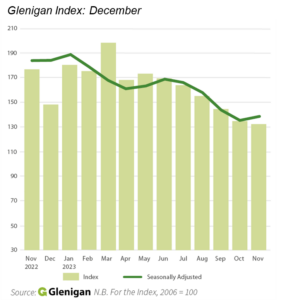
Glenigan’s December 2023 edition of its Construction Index reveals yet another disappointing set of results in a particularly weak year, where the levels of new projects coming online have gradually, and consistently, declined. This time around, work starting on site fell 12% against the preceding three months, finishing 25% lower than 2022 figures.
As the wider economy remains depressed, private investor confidence remains low. It’s led to a persistent slump in activity, with many pausing or pushing back start dates until a greater degree of financial security returns. This is reflected across almost every vertical, with retail being the exception.
Looking at the public sector, the Chancellor’s Autumn Statement, whilst offering a few positive signs in the form of energy infrastructure investment, was not seen as going far enough to support the industry. With a General Election looming and a purdah period likely, many businesses will need to wait until the next Government is in place before firm policy and funding commitments are made.
 Commenting on the findings, Glenigan’s Economic Director, Allan Wilen, says, “Construction starts remain low after sharp falls earlier in the year. However, there are tentative signs that residential activity has begun to stabilise. Private housing starts were little changed on the previous three months. Reflecting the findings of our latest Forecast, this could be taken as the first signs of the recovery expected to kick in during the second half of 2024.
“However, elsewhere high-interest rates and a weak economic outlook continue to deter private non-residential investment while government-funded health and education starts were down sharply on the previous three months.”
Taking a closer look at the sector verticals and regional outlook…
Residential
Residential starts experienced a relatively modest dip (-3%) compared to the preceding three months, falling 12% compared to the previous year.
Drilling deeper, private housing only faltered by 1% against the three months to the end of November, weakening by 14% compared to 2022 levels. Social housing also performed poorly, down 5% on last year and 10% in comparison to the preceding three months.
Non-Residential
Non-residential performance was generally lacklustre, maintaining the downward trajectory that has characterised the UK construction industry in 2023. Overall, project-starts fell 24% against the preceding three months to stand 39% down on a year ago.
Retail provided the sole bright spot amidst the overall gloom, growing 5% against the preceding three months. However, this boost was not enough to prevent the vertical from ending 14% down against the previous year.
Healthcare project-starts crashed, seeing their value literally slashed in half against the preceding three months (-50%) and 2022 levels (-51%).
Industrial project starts also experienced a particularly poor period, with the value of starts decreasing 23% during the three months to November, and remaining 49% lower than a year ago. Likewise, hotel and leisure starts dropped by almost half (-49%) and dived 15% against the previous three months.
Offices followed a similar trend, with the value of project-starts falling 21% on the preceding three months and tumbling 44% compared to the previous year.
Education starts decreased 19% against the preceding three months to stand 13% down on the previous year, whilst community and amenity fell 42% against both periods.
Civils work starting on site plummeted 31% against 2022 figures and by almost a fifth (-18%) measured against the preceding three months. Infrastructure starts decreased 10% compared to the previous three months and was down 20% on the same period last year. Utilities rounded off the vertical analysis in lamentable fashion, with starts declining 31% against the preceding three months to finish 45% lower than a year ago.
Regional Outlook
Unsurprisingly, regional performance was weak during the Index period, with Yorkshire & the Humber, the only one to experience an increase against the preceding three months (+18%), despite finishing a fifth down compared to 2022 levels. Wales in turn slipped back 13% on the previous three months but was up 5% on last year’s figures.
 Some parts of the UK, whilst experiencing decline, were less affected than others. London saw a 3% decrease against the preceding three months and remained 27% down against the previous year. The South East, in turn, only fell by 8% compared with the preceding three months and dropped 16% against the previous year. Furthermore, the value of starts in the South West dipped 3% against the preceding three months and 1% against the previous year.
The impact was more severe in other areas. Starts in the North East and Northern Ireland weakened, slipping by 30% and 29% respectively against the preceding three months and were 22% and 34% lower than a year ago. The East of England experienced even poorer performance, with the value of starts decreasing 19% against the preceding three months and remaining 23% down against the previous year.
The North West also experienced a decrease against the preceding three months (-11%) and previous year (-30%). Scotland also suffered a fall in starts against both the preceding three months (-21%) and the previous year (-35%). The West Midlands and the East Midlands both experienced a weak period, tumbling 22% and 13% respectively on the previous quarter and remaining 34% and 47% down on 2022 levels.
To find out more about Glenigan and its construction intelligence services click here.